Why Heated Insoles Make Sense
A heated insole swaps the footbed in your boot for one with a heating element in the forefoot and a battery either built in or connected by a short cord. You wear your normal socks, the heat comes up from below the toes, and the electronics stay in the boot instead of going through the wash. For anyone who wears one pair of winter boots most of the season, that is a simpler arrangement than charging and washing heated socks.
The trade is coverage. Almost every heated insole warms the underside of the forefoot and toes, not the tops of the toes, so a boot with a thin toe box or a lot of snow on top can still leave you cold. Insoles also add thickness under your foot, which matters in a boot that already fits closely. If you want heat that wraps the toes, or you switch between several pairs of footwear, a heated sock is usually the better tool, and we compare the two directly further down.
The most useful thing to decide before you shop is where you want the battery. Some insoles hide it inside the footbed, some run a cord to a pack at the ankle or boot cuff, and that single choice shapes comfort, runtime and how you charge them.
What to Buy
Five rechargeable heated insoles made the list, ranked on heat coverage, published runtime, battery design, control options and value. Every spec below comes from the brand's own product page or retail listing, checked in October 2026, and scores are our editorial judgment rather than test results.

Therm-ic Heat Flat with C-Pack 1300 B
The heated insole most people should start with. Therm-ic's Heat Flat is a very thin insole with an ultra-fine heating element under the forefoot, and it trims to fit sizes 36 to 48 at marked lines. Power comes from a pair of 1300mAh C-Pack batteries that sit outside the boot, with the cord running up the heel and along the calf. Three heat levels change from a button on the battery or from your phone over Bluetooth, and Therm-ic claims up to 13 hours of heat. Therm-ic lists the set at €199.99 on its European store, with a two-year guarantee.

Mobile Warming Standard Heated Insoles
The simplest way into a heated insole with no cords and no phone. Fieldsheer, which makes the Mobile Warming line, builds the battery into the insole with hidden wiring, so nothing runs up your leg, and a small wireless remote switches between three settings. Fieldsheer claims 2 or more hours on high, 3.5 on medium and 7 on low, with heat concentrated under the toes. The insole trims along printed size guides, comes in small to extra large and charges through a micro-USB port in the insole itself in 3 to 4 hours. Fieldsheer lists it at $99.99, often discounted, with a one-year warranty.
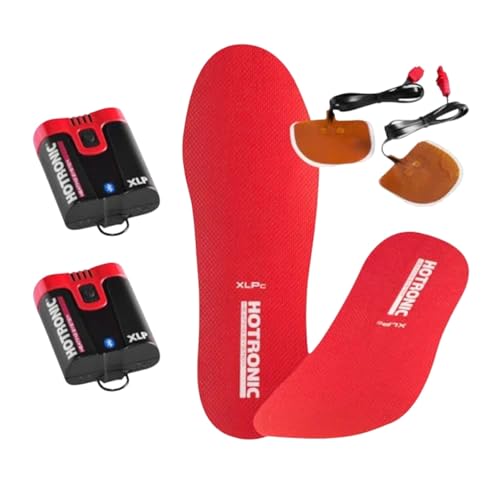
Hotronic XLP 2C BT Foot Warmer
Hotronic is the name ski shops reach for, and the XLP 2C BT is its longest-running set. It is not a full insole: you get two heating elements and Cambrelle covers that fit under your own custom or stock footbed, so a boot fitter's work stays in place. Power comes from two external 6000mAh battery packs, and Hotronic quotes up to 24 hours on the first setting and about 10.5 hours on the third. There are three steady settings plus a Power Boost, all adjustable from the Hotronic Heat app. At a listed $449 it is the most expensive option here, and insoles are not included.
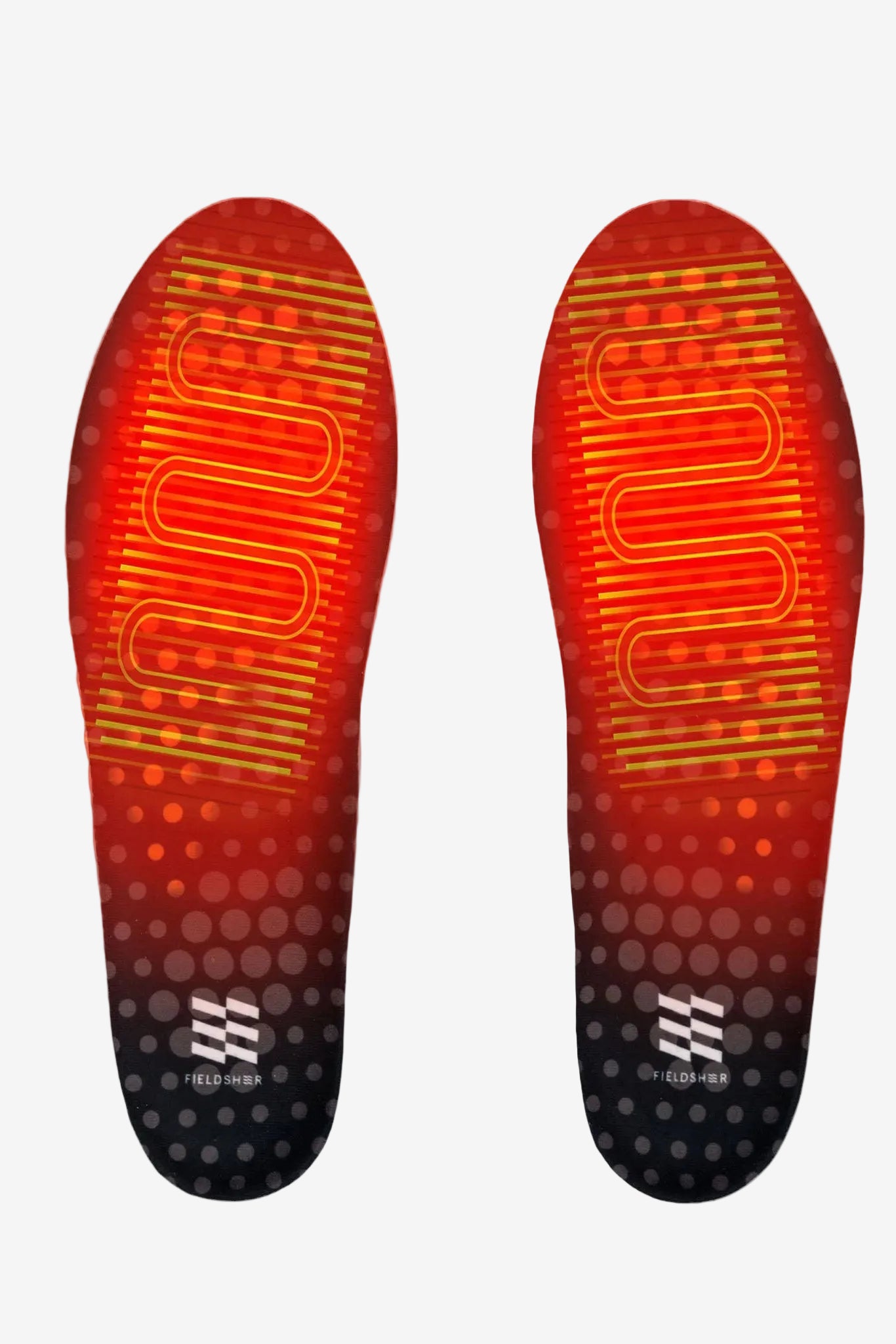
Fieldsheer Premium BT Heated Insoles
The step up from the Standard model, with the same cord-free design and a better battery. Each insole holds a 3.7V 2200mAh battery and charges through a USB-C port, and four settings run from 90 to 135 degrees under the toes. You change the level from a phone or smartwatch through the MW Connect app, or with a waterproof touch button on the insole. Fieldsheer's page lists 7 or more hours per charge in its spec table and up to 9 in its highlights, so plan on 7. Fieldsheer lists it at $169.99, frequently discounted, and sells it direct.
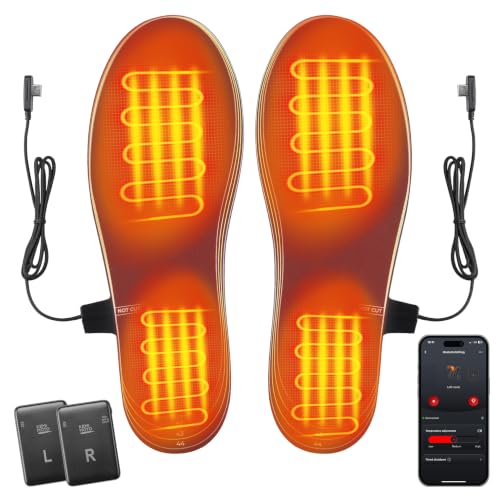
Kemimoto App Control Full-Foot Heated Insoles
Most heated insoles stop at the forefoot. Kemimoto heats the full length of the foot, which suits people who lose warmth through the heel standing on cold ground. The insole connects by USB cable to an external 5000mAh power bank, the largest battery on this list after the Hotronic, and three heat levels change from a Bluetooth app. The insole trims to size at marked lines and comes in small, medium and large. Kemimoto does not publish runtime or temperatures, and the cable has to run up from the insole to wherever you keep the power bank. Kemimoto lists it at $119.99, often on sale.
How They Compare
The table lines up the details that separate one heated insole from another: where the battery lives, how big it is, what each brand claims on its lowest setting and how you control it.
| Model | Battery | Battery location | Claimed runtime, low | Control |
|---|---|---|---|---|
| Therm-ic Heat Flat + C-Pack 1300 B | 1300mAh | External, at the calf | Up to 13 hrs | Button and Bluetooth |
| Mobile Warming Standard | Not listed | Built into insole | 7+ hrs | Wireless remote |
| Hotronic XLP 2C BT | 6000mAh | External, outside the boot | Up to 24 hrs | Button and Bluetooth |
| Fieldsheer Premium BT | 3.7V, 2200mAh | Built into insole | 7+ hrs | Touch button and Bluetooth |
| Kemimoto Full-Foot | 5000mAh power bank | External, by USB cable | Not listed | Bluetooth app |
Every figure is the manufacturer's own claim, taken from product pages and retail listings in October 2026. Runtime claims are best cases on the lowest setting, so expect less inside a cold boot. Where a brand gives no figure, the table says so. Our guide to runtime claims explains why these numbers run optimistic.
The Battery Has to Go Somewhere
Every heated insole is really two design choices: the heating element and the battery. The element is similar across brands, a thin wire or film under the forefoot. The battery is where they split, and it decides more about daily use than any other spec.
Built-in batteries, as in both Fieldsheer models, keep everything inside the boot. There is no cord to snag and nothing to strap to your leg, but the battery adds thickness somewhere under your foot, you charge the insole itself by plugging a cable into it, and when the battery wears out the insole goes with it. External batteries, as on the Therm-ic, Hotronic and Kemimoto, connect by a cord that runs up the back of the heel to a pack at the ankle, calf or boot cuff. They take up less room underfoot, let you swap in a charged spare at lunch and usually hold more energy, at the cost of a cable you have to route each time you put the boots on.
Practical advice: for work boots and everyday winter wear, a built-in battery is the easier life. For ski days, long hunts or anything past about seven hours, pick an external battery you can swap or that holds more charge.
Four Questions That Decide It
Most heated insole regrets come from fit and battery design rather than heat output. These four questions sort the list quickly.
Will It Fit in Your Boot?
Take out your current insole and compare its thickness with the heated one. A ski boot or a fitted hiking boot has little spare volume, and a thick heated insole pushes your foot up into the toe box, which squeezes circulation and makes feet colder. Thin designs like the Therm-ic Heat Flat, or a system like Hotronic that slides under your existing footbed, suit tight boots best. Roomy pac boots and work boots take almost anything.
How Do You Trim It?
Most heated insoles are sold in size ranges and cut down with scissors along printed lines. Trim from the toe and edges only, a little at a time, and check the fit against your old insole as you go. Never cut the heating element or the power cord: Therm-ic, for example, warns against cutting the element under the forefoot, which is where the heat comes from. If your foot falls between two sizes, buy the larger one and trim.
How Long Will You Be Out?
Take the low-setting claim and expect well under the headline figure in real cold. A built-in battery claiming 7 hours on low is comfortable for a work shift on a mild setting; a full ski day on a higher setting calls for a larger external pack. Our guide to how long heated batteries last covers the math, and the same rules apply underfoot.
Remote, App or Button?
A wireless remote, like the Mobile Warming Standard's, is the quickest way to change heat with gloves on. Bluetooth apps add battery readouts and finer control but mean taking out your phone in the cold. A button on an external battery is reliable but awkward if the pack sits under a pant leg. Think about what you will actually be wearing when you want to turn the heat up.
Heated Insoles vs Heated Socks
Heated socks and heated insoles solve the same problem from different directions. A heated sock puts the element right against your skin, often wrapping the toes from above and below, and it works in any shoe you own. The downside is that you need a charged, clean pair for every day you wear them, and the electronics go through the wash with the sock.
A heated insole stays in one pair of boots for the season. You wear whatever socks you like, nothing heated gets washed and moisture from sweat stays mostly in the sock rather than the electronics. In exchange, the heat comes from below only, usually under the forefoot, and moving the insoles between boots means pulling them out and rerouting cords. As a rule of thumb, choose socks if your toes are the coldest part and you change footwear often, and choose insoles if you wear one pair of winter boots most days. People whose feet stay cold indoors and out can find either helpful on a low setting; our guide to heated gloves for Raynaud's covers the same low-and-steady approach for hands, and none of this gear treats any condition.
Four That Did Not Make It
A few heated insoles come up often in searches but did not earn a place on the list.
Thermacell ProFLEX. Long the best-known remote-controlled heated insole in the US, but retailers now list it as out of stock or discontinued, and Heat Factory's ProFLEX Outdoor version is marked discontinued too. We would rather not recommend something you may not be able to buy.
Hotronic XLP 1C. A cheaper Hotronic set at a listed $299 with a single battery pack of about half the 2C's capacity. It is a reasonable choice for shorter ski days, but Hotronic publishes fewer runtime details for it.
ORORO heated insoles. ORORO once sold a trim-to-fit rechargeable insole on Amazon, but we could not find a current model with published specs.
Unbranded 5000mAh app insoles. Amazon carries many generic heated insoles with large power banks and app control. Without a named brand, a warranty you can use or published runtime, we left them out.
The Specs That Actually Matter
Heated insole listings are crowded with numbers. These are the ones worth reading and the ones you can skip.
Worth checking
- Insole thickness compared with the one already in your boot
- Where the battery sits and whether you can swap it
- Heat zone: forefoot only or full foot
- Trim lines and a clear warning about where not to cut
- Published runtime for each setting, not just the best case
Safe to ignore
- Power bank capacity with no runtime attached to it
- Peak temperatures that apply only on high
- Heat-up times measured in seconds
- Vague claims of fitting "all shoes"
- App features you will never open in the cold
Common Questions
Short answers to the questions people ask most before buying heated insoles.
What are the best heated insoles?
For most people, the Therm-ic Heat Flat with C-Pack 1300 B batteries offers the best balance of thin fit, runtime and control, with a claimed 13 hours and Bluetooth. If you want no cords at all, the Mobile Warming Standard with its wireless remote is the simpler choice, and skiers who want the longest runtime should look at the Hotronic XLP 2C BT.
How long do heated insoles last on a charge?
Manufacturer claims for the insoles here run from about 7 hours on low for built-in batteries to as much as 24 hours on the lowest setting for Hotronic's 6000mAh packs. On high, expect roughly 2 to 3 hours from a built-in battery. Real cold shortens all of these figures.
Can you cut heated insoles to size?
Most can be trimmed along printed lines at the toe and edges. Never cut through the heating element, which sits under the forefoot, or through the power cord. Trim a little at a time and check against your old insole.
Do heated insoles work in ski boots?
Yes, if they are thin enough. Ski boots leave little room, so a thick insole can press your foot into the shell and cut circulation. Systems like Hotronic that fit under your existing footbed, or very thin insoles like Therm-ic's Heat Flat, are made for ski boots.
Are heated insoles warmer than heated socks?
Not usually. Heated socks put the element against your skin and often wrap the toes, while insoles heat from below only. Insoles win on convenience: they stay in one pair of boots, never go through the wash and work with any sock you like.
Can I take heated insole batteries on a plane?
Yes, in your carry-on. FAA rules require spare lithium-ion batteries to travel in the cabin, and packs under 100 watt-hours need no airline approval. A 3.7V 2200mAh insole battery works out to about 8 watt-hours, far below that limit.
Which One Should You Buy?
Buy the Therm-ic Heat Flat with C-Pack 1300 B if you want one set of heated insoles that is thin, long-running and easy to control.
Choose the Mobile Warming Standard if you want a cord-free insole with a simple remote for work boots and daily wear, or the Fieldsheer Premium BT if you want that same design with a bigger battery and app control.
Spend on the Hotronic XLP 2C BT if you ski often and want to keep your custom footbeds, and pick the Kemimoto if your heels get as cold as your toes and you want full-foot heat.