Most heated jacket liners do not heat your arms
Start with the naming, because it trips people up. A heated jacket liner is a thin heated layer worn under a coat or a riding jacket. It is not a heated glove liner, which is a thin heated glove worn inside a bigger glove. Both get called liners, they cost roughly the same, and the search results mix them together.
Now the part nobody tells you. Check the heating zones on any battery powered liner and you will usually find them on the chest, the collar and the mid back. The sleeves are just fabric. Heated sleeves are, in practice, a 12V feature: the two wired liners below both run heat down the arms, and neither battery jacket does.
That reframes the whole decision. If you want warm arms, you are shopping for a 12V liner and you need a motorcycle to power it. If you do not, you are shopping for core warmth, and a heated vest does that job for less money than any of these.
If you are not on a motorcycle
These run off a rechargeable pack in an internal pocket, so they work anywhere. Both are ORORO, a brand we have reviewed and the one with the clearest support record in heated apparel. Neither heats the sleeves, and both say so in their own zone descriptions if you read them closely.
As an Amazon Associate we earn from qualifying purchases. How we make money

ORORO Men’s Heated Fleece Jacket
Fleece is the thinnest thing ORORO makes, and thin is the whole requirement for a layer worn underneath something. Four zones cover the left and right chest, the collar and the mid back, running off an included 7.38V 4800mAh battery for up to eight hours. Be clear about what that means: this is a heated core layer with ordinary fleece sleeves attached. The sleeves are warmer than bare arms and that is all.

ORORO Men’s Softshell Heated Jacket
Included for a reason specific to this site: two of its four heating zones are in the hand pockets. The others are the collar and the mid back. It is the only jacket here that puts heat directly against your hands, which is worth knowing if cold fingers are what brought you. It is also an outer layer rather than a liner, with a water and wind resistant shell, FELLEX insulation, a detachable hood and a 6800mAh battery rated to 13.5 hours on low.
If you ride
These are the liners that heat your arms. Neither contains a battery, and neither is usable out of the box. Both manufacturers state that a temperature controller is a separate purchase, and Gerbing states that a battery harness is required as well. Budget for that before you compare either price against a battery jacket.

Firstgear Gen4 Heated Jacket Liner
The most heat on this page and the cheaper of the two wired liners, which is not the order you would guess from the prices. Firstgear rates it at 106 watts across seven carbon panels covering the chest, lower front, arms, collar and upper and lower back. The wrists carry coaxial glove plugs that stow in zipped pockets, so heated gloves run off the same circuit. Firstgear’s own spec sheet says windproof, and lists an MSRP of $224.99, which makes the Amazon price a real discount.
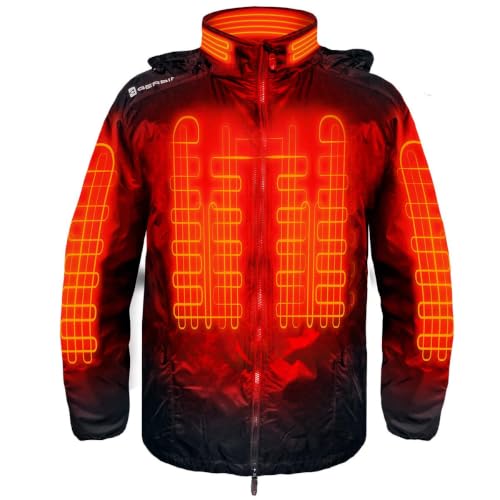
Gerbing 12V Heated Jacket Liner 2.0
Buy this for the build and the warranty rather than for raw output, because Gerbing rates it at a maximum of 135 degrees at 77 watts, below the Firstgear. What you get for the extra money is Microwire elements carrying a lifetime warranty, a water resistant mini ripstop shell, a snow skirt, a removable hood and a packable pocket, plus seven zones including two in the sleeves. It also acts as the hub for Gerbing gloves, pants and socks on one controller, which is the argument if you are building a whole wired setup.
How they compare
| Model | Power | Heats sleeves | Runtime | Also need to buy |
|---|---|---|---|---|
| ORORO Fleece | Battery | No | Up to 8 hrs | Nothing |
| ORORO Softshell | Battery | No | Up to 13.5 hrs | Nothing |
| Firstgear Gen4 | 12V, 106W | Yes | Unlimited | Controller |
| Gerbing 12V 2.0 | 12V, 77W | Yes | Unlimited | Harness, controller |
Runtime figures are the manufacturers’ own, measured on the lowest setting. Expect closer to a third of that in real cold. Prices shown are for a single size, since heated liners are usually listed size by size rather than under one parent listing.
Battery or 12V
Everything else on this page is detail. This is the choice that decides whether you are happy with what arrives.
Buy a battery jacket if you walk away from the vehicle
Site work, deer stands, dog walking, market stalls, spectating, anything where you are on your feet and untethered. You get several hours depending on the setting and the weather, and you can recharge from a normal charger. The ceiling on heat is lower, the sleeves are unheated, and neither of those matters much if you are wearing a proper coat over the top.
Buy a 12V liner if the bike is the point
Wired heat at highway speed in January is a different experience, it covers your arms, and it does not quietly die ninety minutes from home. The cost is that it only works while connected to a vehicle. If you commute by bike and then stand around outside at the other end, you are buying a garment that stops working exactly when you step off it. Our guide to 7.4V against 12V works through that trade-off in full, and the motorcycling guide covers the glove half of a wired setup.
Check before you buy: Amazon listings for 12V liners frequently do not mention that they need a vehicle at all. The Firstgear listing’s only description bullet says the liner warms you in seconds, with nothing about power. The manufacturer’s site is where you find that it is designed to plug into a DC source and that the controller is extra. If a heated garment’s listing never mentions a battery, assume there is not one in it.
Liner, vest, or gloves?
A vest if you are not riding
This is the recommendation most of these roundups avoid making. If a battery jacket’s heat lands on your chest, collar and back, then it is doing a vest’s job while charging you jacket money. A heated vest heats the same zones, costs less, and leaves you free to put whatever sleeves the weather actually demands over the top. Buy the jacket instead if you want one garment rather than a system.
A 12V liner if your arms are the problem
Wind hits your arms directly at speed, and no battery garment on this page addresses that. If cold arms and shoulders are what you are trying to solve, the wired liners are the only real answer here, and they come with a motorcycle attached as a requirement.
Gloves if the cold stops at your hands
No jacket reaches your fingers, with the partial exception of the heated hand pockets on the softshell, which only help while your hands are in them. If the rest of you is comfortable and your hands still go numb, heat needs to be at the hand. Our main heated glove guide covers what to buy, and our guide to gloves for Raynaud’s covers the circulation case specifically.
Both if you work outdoors all winter
A heated layer and gloves together let you run each on a lower setting, which extends runtime on both packs. Our heated work gloves guide covers the glove half of that pairing.
The specs that matter
Worth checking
- Exactly which zones are heated, named one by one
- Whether a battery, or a harness and controller, is included
- Wattage on a 12V liner, which is the honest heat number
- Whether the wrists carry glove connectors
- Whether it is machine washable once the electronics are out
Safe to ignore
- Headline runtime, which assumes the lowest setting indoors
- Zone counts on their own, since four zones can miss your arms entirely
- Peak temperature claims nobody runs continuously
- Reseller copy, which contradicts manufacturer spec sheets more often than you would expect
- Colour options, which often carry different prices for no reason
Fit a liner close, not loose
With heated gloves the rule is to size up, because a tight glove restricts the circulation you are trying to help. A liner is the opposite. The elements warm you by contact, so a loose liner heats an air gap rather than you. Both 12V makers say the same thing in their own copy: wear it close to the body, over a thin base layer and under your outer jacket. Buy your normal size and allow only for that base layer.
Then check the stack. The most common complaint about liners is not warmth, it is that the finished combination of base layer, liner and outer jacket is too thick to zip or too tight across the shoulders to reach the bars. If you are buying for a riding jacket you already own, try both together before the return window closes.
One more thing riders get wrong: cuffs. A liner sleeve that bunches at the wrist will not sit under a gauntlet glove, and on the wired liners it is also where the glove connectors live. Snug cuffs matter more here than anywhere else on the garment.
On care, remove the battery or disconnect the leads first. All four here are washable in some form, but the Gerbing and Firstgear liners are hand wash rather than machine wash, so check the label rather than assuming. Our guide to washing heated gear covers what is safe.
Common questions
Do heated jacket liners heat your arms?
The 12V ones do. The battery powered ones usually do not. Both wired liners here run heat down the sleeves, while both ORORO jackets concentrate their four zones on the collar, back, chest or hand pockets and leave the sleeves unheated. Read the zone list rather than the zone count, because four zones can still miss your arms entirely.
Are heated jacket liners the same as heated glove liners?
No, and the shared name causes real confusion. A glove liner is a thin heated glove worn inside a larger glove. A jacket liner is a heated torso layer. They are unrelated products at similar prices, so read the listing title rather than the thumbnail.
Can you use a 12V liner off the motorcycle?
Only with a separately purchased portable 12V pack, and the draw is substantial. Gerbing rates its liner at 6.4 amps. This is not something a phone power bank will run. If you need warmth both on and off the bike, a battery jacket is the more honest answer.
What else do you have to buy with a 12V liner?
At minimum a temperature controller, which both manufacturers sell separately, and for Gerbing a battery harness as well. Gerbing states plainly that a controller is required and warns that going without one risks discomfort and burns. Treat the sticker price as a starting point.
How long does a battery jacket last on a charge?
Expect roughly a third of the advertised figure on a warm setting outdoors, since cold cuts battery capacity and nobody runs these on the lowest setting in real weather. Our guide to battery life covers how many seasons a pack itself lasts.
Is a heated liner waterproof?
No, and be careful with listings that say otherwise. Firstgear specifies windproof. Gerbing specifies a water resistant shell. Water resistant means it will handle spray and light rain, not sustained wet, which is another reason a liner belongs under a proper outer jacket.
Which one should you buy?
Buy the ORORO Fleece if you want a thin heated layer to wear under a coat and you accept that the warmth lands on your core. It is the cheapest sensible option here and the battery is included.
Buy the ORORO Softshell if cold hands are the actual problem and you want one jacket rather than a system. Heated hand pockets and 13.5 hours of runtime are a genuinely different proposition from everything else on this page.
Buy the Firstgear Gen4 if you ride. It is the most heat here, it covers your arms, it has glove plugs at the wrists, and it costs less than the Gerbing. For most riders this is simply the pick.
Buy the Gerbing 12V 2.0 if you are building a full wired setup or you want the lifetime element warranty and the better shell. Just go in knowing you are paying more for a liner that puts out less heat.
And if you are not riding and your arms are fine, buy a vest. Nothing in the battery half of this page heats your sleeves, so you would be paying jacket prices for vest coverage.