A heated glove is four components working together: a battery, a controller, a heating element and insulation. The first two are commodity parts that barely differ between a $70 pair and a $250 pair. Almost everything that separates a glove worth owning from one that disappoints sits in the last two.
Understanding how the system works turns a spec sheet from marketing noise into something you can read. It also explains the three complaints people have about heated gloves, which are that the fingertips stay cold, that the runtime never matches the box, and that the battery died after two seasons.
Resistive heat on a 16.8 watt hour budget
Current runs through a resistive element, the element gives off heat, and a small lithium pack decides how much of it you get and for how long.
- The element is a stainless steel or carbon fiber thread sealed in a flexible coating. What matters is not the material but whether it reaches your fingertips.
- The battery is almost always 7.4 volts and 2200 mAh, which is 16.8 watt hours of stored energy. That number caps everything else.
- The controller sets a power level, not a temperature. Consumer battery gloves have no thermostat and no feedback loop.
- The insulation decides how much of that heat stays near your hand. On roughly 7.5 watts, it is doing more work than the element is.
The four parts of a heated glove
Nothing here is exotic. The technology is resistive heating, the same principle as a toaster element, scaled down and made flexible enough to bend around a knuckle.
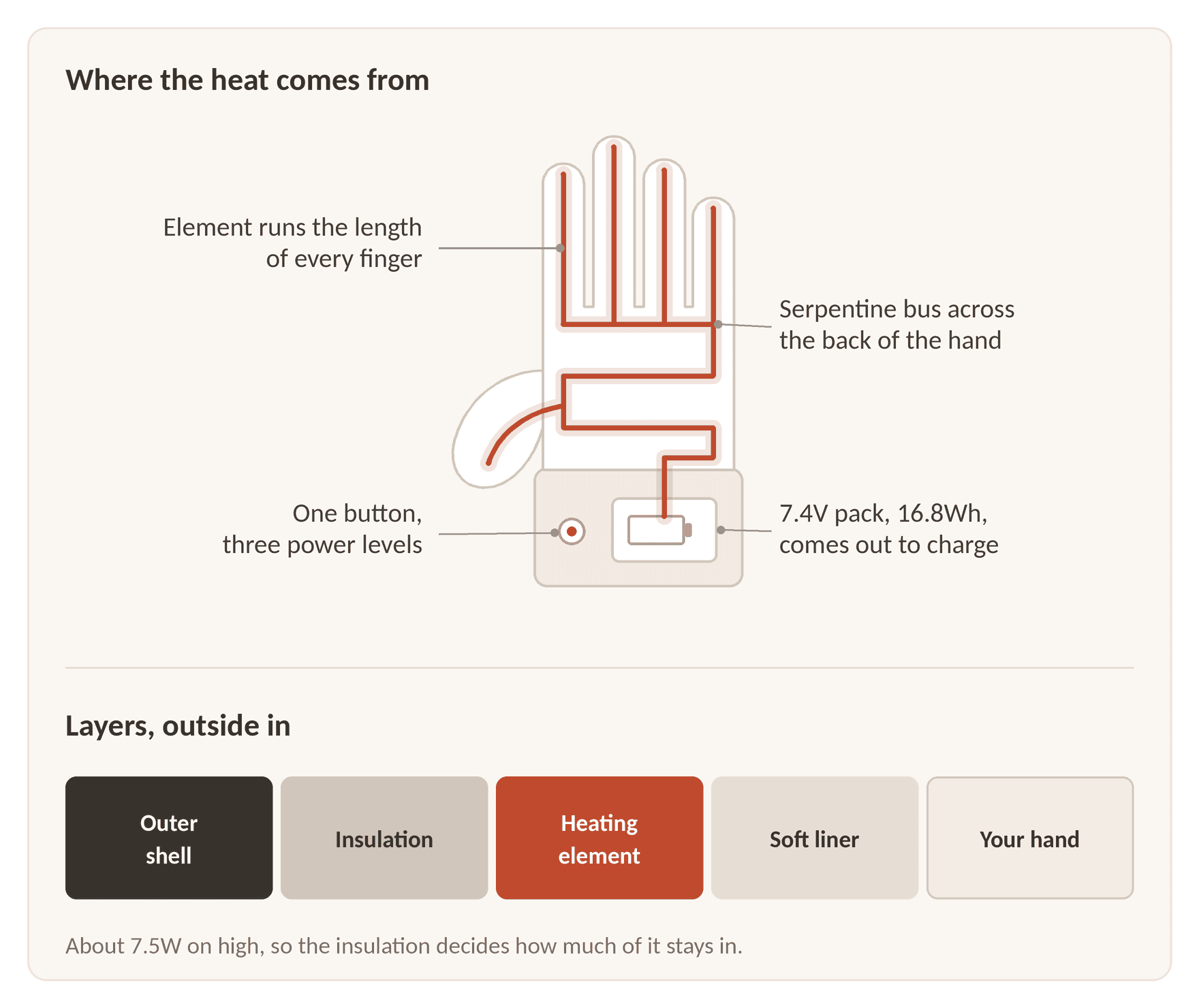
The heating element. Push current through a material that resists it and the resistance releases energy as heat. The engineering problem is doing that with something thin enough to flex thousands of times, safe enough to sit against skin, and durable enough to survive getting soaked. Gerbing uses what it calls Microwire, described as micro-sized stainless steel fibers intertwined and sealed inside a waterproof coating. Savior uses far-infrared carbon fiber panels. ORORO uses composite coated elements wrapped in silica rubber to prevent short circuits. All three do the same job, and the difference that matters is coverage, not the trade name.
Coverage is what to read carefully. Routing elements down every finger and the thumb costs more to manufacture than laying a single panel across the back of the hand, so it is the first thing cut on budget gloves. Gerbing’s G4 spec states heating throughout the glove including the tip of every finger. Savior states coverage across the entire back of the hand and fingertips. If a listing only mentions the back of the hand, that is not an oversight in the copywriting.
The battery. Battery powered gloves have standardised on 7.4 volt lithium polymer packs, usually 2200 mAh, which works out to 16.8 watt hours of stored energy. Each glove carries its own pack in a zippered pocket at the wrist, and they come out for charging, typically a four hour job. Some brands offer a 3000 mAh option for thicker gloves that adds an hour or two. That 16.8 watt hour figure is the honest constraint on the whole product, because everything about how hot the glove runs and for how long is a division problem against it.
The controller. One button on the cuff, three settings, an LED that changes colour. What that button adjusts is the power level delivered to the element, not a target temperature. Most consumer battery gloves have no temperature sensor and no feedback loop, so they are not thermostats. They push a fixed amount of power, and what you actually feel depends on how cold it is and how fast the wind is stripping heat off your hands.
The insulation. The element makes heat and the insulation decides how much of it stays near your hand rather than leaking into the air. This is why the better heated gloves still quote conventional insulation figures, like the 150 grams of 3M Thinsulate in Gerbing’s G4 and GT5, and why a heated glove built on a thin unlined shell performs badly no matter how good its element is.
A test you can run in a shop. A well built heated glove should be a decent winter glove with the battery removed. If it feels thin and unlined in your hand with the power off, the insulation was an afterthought and you are buying a heating pad with fingers.
What the heat settings actually do
Savior publishes figures for its thin liner model that show the trade clearly. Each step up in heat roughly halves the runtime, because the stored energy is fixed and the setting only decides how fast you spend it.
| Setting | Surface temperature | Runtime | Approximate draw |
|---|---|---|---|
| High | 140 to 150°F | 2 to 2.5 hours | About 7.5W |
| Medium | 122 to 131°F | 3 to 3.5 hours | About 5W |
| Low | 100 to 113°F | 6 to 6.5 hours | About 2.7W |
Temperatures and runtimes are the manufacturer’s published figures. The draw column is not: it is 16.8 watt hours divided by the quoted runtime, which is the arithmetic that has to hold for the published figures to be true.
Seven and a half watts is roughly the output of a nightlight bulb, and that is the entire heat budget keeping your hand warm on the highest setting. It explains why heated gloves supplement insulation rather than replacing it, and why the insulation layer is not a detail.
It also explains the most useful habit to build. Run low or medium while you are moving and save high for when you stop. Walking generates heat on its own. Standing at a bus stop does not.
Why motorcycle gloves run on 12 volts
Gloves wired into a motorcycle, snowmobile or ATV are not rationing a pack in your cuff, so they work on an entirely different power budget. Gerbing’s 12 volt G4 draws 1.1 amps per glove for 13 watts each, and the G3 and T5 models draw 2.2 amps for 27 watts. Runtime connected to the vehicle is effectively unlimited.
Battery powered
- About 7.5 watts on high. Enough to supplement good insulation, not enough to fight sustained wind chill.
- Two to three hours at full output. Fixed by the 16.8 watt hours in the pack.
- Goes anywhere. No wiring, no vehicle, nothing to unplug when you get off.
Wired 12 volt
- 13 to 27 watts. Two to three times the output, which is what highway speeds actually require.
- Unlimited runtime. The bike is the battery, so the only limit is the ride.
- Needs a controller. Gerbing sells one separately and recommends it, warning that skipping it can cause discomfort and burns.
That last point is worth sitting with. A manufacturer only issues a burn warning on a system with enough power behind it to cause one, which is the clearest statement available of the gap between the two categories.
Gerbing’s GT5 hybrid makes the trade explicit, since it runs either way. On a 12 volt 9000 mAh pack it manages one hour on high, 2.5 on medium and four on low. The same glove on vehicle power runs all day. If you are weighing the two systems, our guide to 7.4V against 12V covers which suits which rider, and our best heated gloves for motorcycling guide covers the wired options in detail.
Why runtime claims come in short
Two effects compound, and neither is dishonesty on the manufacturer’s part. ORORO footnotes its runtime figures as tested at 77°F, and that footnote is the key to the whole problem.
The first effect is chemistry, because lithium cells deliver less usable capacity as they get colder. The second is physics, because heat loss rises with the temperature difference between your hand and the air. The colder it is, the more of that limited budget you burn to hold the same feeling, which pushes you to a higher setting, which drains the pack faster. The conditions that make you want the gloves are the same conditions that shorten their runtime.
Our explainer on heated glove runtime claims covers how far off the advertised figures typically land and how to estimate what you will actually get.
Why the fingers are the problem
Fingers are thin, which gives them a large amount of surface area for very little volume, so they shed heat faster than any other part of the hand. They also sit at the end of the circulatory line, and when your core temperature starts dropping, your body narrows the vessels feeding your extremities to protect itself. Fingertips lose blood flow first and get cold first.
A panel across the back of the hand does warm blood passing through, and some of that warmth carries forward. It is an indirect route, and for most people in real cold it is not enough. Elements routed along the length of each finger put the heat on the tissue that is actually failing, which is why the specification to read is not the watts or the milliamp hours but the sentence describing where the wire goes.
The same logic explains why a heated liner can outperform a thicker glove on paper, since the element sits directly against your skin rather than outside a layer of insulation. Whether that is the right choice comes down to whether your gloves have spare room, which our comparison of heated gloves against liners walks through.
What fails, and when
Batteries go first, usually as a gradual loss of runtime rather than a sudden death. Lithium polymer packs of this type are rated for a few hundred charge cycles, so a glove worn daily through several winters will notice. They are also the cheapest component to replace, which is a good reason to favour brands that sell spares rather than treating the whole glove as disposable.
Connectors go second. The DC jack in the wrist pocket is a small plug that gets flexed, yanked and rained on, and it is the most common hard failure in the category.
Heating elements rarely fail in good gloves, which is worth knowing when you compare warranties. Gerbing offers a lifetime warranty on its Microwire elements. A manufacturer only makes that offer on a component it expects not to come back, and in a category where most warranties run a single year, that difference is a genuine signal rather than a marketing line.
How to read a spec sheet
Three lines tell you most of what you need. Look for element coverage that explicitly includes the fingers and thumb, not just the back of the hand. Look for battery capacity, converting to watt hours if you want to compare across voltages, since 7.4 volts times 2.2 amp hours gives 16.8. Look for a stated insulation weight, which tells you whether there is a real glove underneath the electronics.
Then check whether the brand sells replacement batteries at all. A glove with a proprietary pack and no spares available is a two or three winter product being sold at a five winter price, and no amount of clever heating technology fixes that.
Ready to choose a pair? Our guide to the best heated gloves applies these three checks to the pairs worth buying, sorted by what you need them for.
Frequently asked questions
How do heated gloves actually produce heat?
Resistive heating, the same principle as a toaster element. Current from a lithium battery passes through a flexible element woven into the glove, and the element’s resistance converts that electrical energy into heat. The engineering challenge is making something that flexes thousands of times, survives moisture and is safe against skin, which is why brands seal the fibers inside proprietary coatings.
How hot do heated gloves get?
Published surface temperatures cluster around 135°F, with Savior quoting 140 to 150°F on its highest setting and Gerbing quoting 135°F for its 12 volt gloves. That is a surface figure measured at the element, not the temperature your skin experiences, which is lower and depends heavily on how cold the air is.
Do heated gloves have a thermostat?
Battery powered consumer gloves generally do not. The button selects a power level and the element delivers it regardless of conditions, so the same setting feels very different at 40°F and at 10°F. Wired 12 volt systems are the exception, and Gerbing recommends adding a temperature controller to those precisely because the output is high enough to need regulating.
Why does my battery die faster in winter?
Two reasons at once. Lithium cells deliver less capacity when they are cold, and colder air pulls heat away from your hand faster, which pushes you to a higher setting. Manufacturer runtimes are measured in warm rooms, so treat the low end of any quoted range as the realistic figure once temperatures drop below freezing.
Can I replace the batteries when they wear out?
On most reputable brands, yes, and you should plan to. The packs are rated for a few hundred charge cycles and are the first component to degrade. Check that replacements are actually sold for the model you are buying before you commit, because a proprietary pack with no spares available turns a multi-season purchase into a disposable one.
Are heated gloves still warm when the battery dies?
A well made pair is, because the insulation does most of the work regardless of whether the element is running. That is the useful test when comparing models: if the glove feels thin and unlined with the power off, the heat is compensating for a poor glove rather than improving a good one.