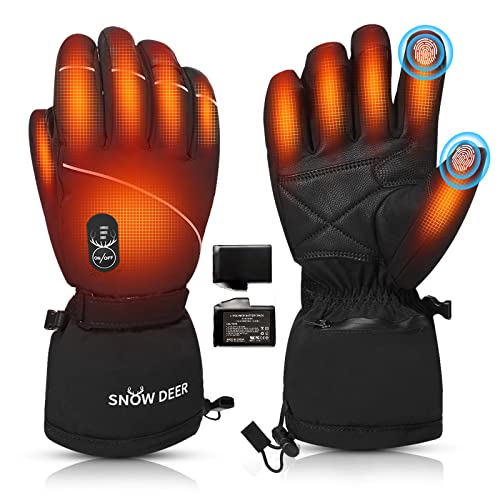
The most heat per dollar on this site, with a caveat the brand admits to. Independent testing put these at 154F on the highest setting, second hottest in a pool of competitors, and the heating runs right out to the fingertips rather than stopping at the knuckles. But Snow Deer itself says the gloves are built for use above 14F and may not insulate enough in genuine cold. Buy them for output, not for arctic conditions.
Lots of heat, ordinary insulation
Two things get said about Snow Deer heated gloves and they appear to contradict each other. Independent testers measure them among the hottest gloves available. Owners in real cold report being cold anyway.
Both are true, and the explanation is the most useful thing in this review. A heated glove does two jobs: it adds heat, and it holds heat. Snow Deer is excellent at the first and unremarkable at the second. The elements are powerful and they reach the fingertips, but the insulation around them is ordinary, so in mild cold you get a glove that feels genuinely hot, and in severe cold you get heat leaving almost as fast as it arrives.
Snow Deer has effectively confirmed this. Replying to a customer complaint about performance, the company said the gloves are designed for temperatures above 14F and may not provide enough insulation in extreme freezing conditions. That is a manufacturer volunteering a limit on its own product, and it is not mentioned in any other review of these gloves that we can find.
Strong in two places, average in three
Our scores, based on independent testing, owner reports and manufacturer documentation. We have not tested these gloves ourselves, and our method page explains what that does and does not mean.
154F, and heat that reaches your fingers
Testers at CNN Underscored put an infrared thermometer on a pool of heated gloves and found Snow Deer reaching 154F on the highest setting, beaten only by one competitor. For context, most heated gloves top out somewhere in the 130s to mid 140s. This is a glove with genuinely powerful elements.
More important than the peak number is where the heat goes. Field & Stream noted that the heating wires run the full length of every finger to the tip, which is why the brand keeps appearing in recommendations for arthritis and poor circulation. Most heated gloves warm the back of the hand and the first knuckle and stop there, which is a problem because fingertips are where cold is felt first and where circulation is worst.
Owner reports back this up more consistently than they back up most claims in this category. The recurring theme is surprise that the heat actually arrives at the fingertips, from people who had bought other heated gloves and found it did not.
Why this matters more than the peak figure: a glove that reaches 154F at the back of the hand and 100F at the fingertips is worse than one reaching 130F evenly. Snow Deer does both, which is the single strongest thing about it.
The 14F problem
Here is the part you will not find elsewhere. In a public reply to a customer who found the gloves underperformed, Snow Deer said they are intended for use above 14F, that they work in mild to moderate cold, and that they may not insulate sufficiently in extreme freezing conditions.
Read that carefully, because it is unusually candid and it should change how you evaluate the glove. It is not saying the heating fails. It is saying the insulation is not built for severe cold. Those are different failures with different consequences.
In practice this means the gloves perform best exactly where they get their good reviews: a cold morning, a football game, a ski day in moderate conditions, a walk. It also means that if you are buying heated gloves because you work outdoors in genuinely severe cold, this is the wrong glove and no amount of heat output fixes it, because the heat leaves as fast as the elements produce it.
It also explains the split in owner reports better than any other theory. People describing these as the gloves that saved their hands and people describing them as inadequate are often both accurate, and the difference is the temperature they were standing in.
Claims that survive contact with measurement
Snow Deer publishes 2.5 to 6 hours from a pair of 7.4V 2200mAh packs, with a full charge taking three to four hours. Independent testing found roughly two and a half to three and a half hours on the highest setting. Owners report three to four hours on high, and considerably more on low, with one describing nearly nine hours at an outdoor event by cycling the heat on and off as needed.
Those figures agree with each other, which is worth pausing on. Across this site the usual pattern is a manufacturer claim roughly double what testing finds, most visibly with Savior Heat. Snow Deer quotes a range wide enough to be honest at both ends, and the measured numbers sit inside it. That is a small thing that tells you something about the company.
The practical reading: treat this as a three hour glove on high and a six hour glove on low, and plan around the low figure. Our guide to runtime claims covers why cold weather shortens both, and our guide to battery life over seasons covers how to stop the packs degrading between winters.
One design detail earns praise. The battery sits on the inside of the forearm just below the wrist rather than on top, and testers found it barely noticeable in wear. The control button doubles as a display, showing both the heat setting and the remaining battery level, which is more than most gloves at any price offer.
Sheep leather palms, an unheated palm, and one weak point
Soft sheep leather covers the whole palm and fingers, with water-resistant windproof polyester across the back of the hand and a breathable fleece lining inside. Field & Stream rated the construction highly and noted better dexterity than the thickness suggests, helped by the leather palm giving grip that a fabric shell does not. The wrist adjusts with Velcro.
The palm is not heated. Heating covers the back of the hand and the five fingers, and stops there. This is worth knowing because it produces a specific complaint that recurs in owner reviews: the tops of the hands feel warm while the palms go cold from contact with whatever you are holding. If you are gripping cold metal for long periods, no heated glove in this family solves that.
Weather resistance holds up for ordinary conditions. Testers left them out through an hour of snowfall and found the interiors still dry. This is water and wind resistant rather than a named waterproof membrane, so treat it as adequate for snow and unequal to sustained rain.
The one criticism worth taking seriously concerns the battery pockets, which close with Velcro rather than zips. Testers found them less secure looking than the alternatives in their pool, and while nothing came loose during testing, a battery pocket that opens on a chairlift or in a treestand loses you an expensive component.
On sizing, go up more than you normally would. These run small, and the complaint is consistent. One owner who usually buys XXL found that even a XXXL fitted snugly rather than loosely. That matters twice over: a tight heated glove restricts the circulation you are paying to improve, so the size error costs you warmth as well as comfort. Buy where returns are easy.
Owner reports
Owner feedback splits cleanly along the line the manufacturer drew: warm enough in moderate cold, not enough in severe cold. The praise and the complaints are mostly about different weather.
What comes up repeatedly
- Heat genuinely reaches the fingertips, which surprises people who own other heated gloves
- Worked for outdoor work through a Montana winter where other gloves had failed
- Nearly nine hours at an outdoor event by switching the heat on and off as needed
- Battery life close to what the listing states, which buyers note as unusual
- Comfortable enough that the battery is forgotten in wear
What people complain about
- Battery drains quickly on the highest setting, requiring frequent recharging
- Insufficient in extreme cold, which matches the manufacturer’s own stated limit
- Sizing runs small, with one owner finding XXXL fitted where XXL usually does
- Palms go cold from contact, because the palm is not heated
- Gloves arrive in unbranded packaging, leading buyers to assume counterfeits
Drawn from retailer reviews and independent testing rather than our own use. On the packaging point, Snow Deer states that it ships in neutral packaging for logistics reasons and that the products are genuine. It is not a product fault, but it causes returns, so it is worth knowing before you open the box.
Strengths and weaknesses
What it does well
- 154F measured on high, among the hottest available
- Heating runs the full length of every finger to the tip
- Runtime claims that match what testing actually finds
- Battery sits under the forearm and is barely noticeable
- Control button shows heat setting and battery level together
- Sheep leather palms give grip a fabric shell does not
What holds it back
- Manufacturer states it is built for use above 14F
- Around three hours on high, less in real cold
- Battery pockets close with Velcro rather than zips
- Water resistant only, with no membrane named
- The most expensive glove we have covered outside Volt
- Unbranded packaging that reads as counterfeit to buyers
The numbers
Peak temperature and measured runtime come from independent testing with an infrared thermometer. Everything else is manufacturer specification. The stated lower limit comes from Snow Deer’s own reply to a customer review.
Snow Deer and Savior Heat are the same company
This matters if you are comparing the two, because most people assume they are competing brands. They are not. Replying publicly to a customer who complained that his Snow Deer gloves arrived Savior-branded, the Snow Deer official store confirmed that both are their brands and that they share core battery and control technology. The seller name on that listing is Savior.
Savior’s own product page says the same thing from the other direction. Their entry-level glove is described as using the heating system fitted across every grade they make, which they call their core technology.
So when you put the two side by side, you are not choosing between manufacturers. You are choosing between two shells built around one heating system.
| Snow Deer Upgraded | Savior Heat S66B | |
|---|---|---|
| Battery | 7.4V, 2200mAh pair | 2200mAh, 3000mAh optional |
| Heat settings | Three | Three |
| Heated area | Back of hand, five fingers | Back of hand, five fingers |
| Palm heated | No | No |
| Palm material | Full sheep leather | Fabric, leather fingertip |
| Lining | Fleece | Velvet with cotton |
The engine is shared and the body is not. Snow Deer puts soft sheep leather across the whole palm and fingers where Savior uses fabric with a conductive leather patch on the index fingertip. That is the difference you are paying roughly ten dollars for, and it buys grip and durability rather than warmth.
What to do with this: if you were planning to compare Snow Deer against Savior to find the better heating, stop, because it is the same heating. Choose on the palm. If you handle tools, reins, poles or anything that needs grip, the leather palm is worth the difference. If you do not, the cheaper Savior does the same job. Our Savior Heat review covers that glove in full.
What else to consider at this price
At $129 this is not a budget glove. The ORORO All-Around costs less, comes from a different manufacturer, and has the better support record. It does not get as hot, and its heating is less thorough at the fingers. If you want the most reliable everyday glove, buy that instead.
If your problem is circulation rather than weather, the fingertip coverage here is a real advantage, and our guide to heated gloves for Raynaud’s explains why coverage matters more than peak output. Note that neither of these gloves heats the palm, which is worth knowing if that is where your circulation problems show up.
If you need severe cold rather than moderate cold, look at gloves that name a waterproof membrane and carry more insulation. Our skiing guide covers several, and for a long motionless sit our hunting guide covers the trade-off between warmth and getting your fingers back.
And if you ride, none of this applies. A battery at the wrist cannot keep up with wind at speed, which is covered in our motorcycling guide.
Common questions
Are Snow Deer heated gloves any good?
Yes, for moderate cold. They produce more heat than almost anything we have looked at, measured at 154F on the highest setting, and the heating reaches the fingertips rather than stopping at the knuckles. The limitation is insulation rather than heating: Snow Deer says the gloves are designed for use above 14F and may not be enough below that.
How long do Snow Deer heated gloves last on a charge?
Around two and a half to three and a half hours on the highest setting and up to six on the lowest, from a pair of 7.4V 2200mAh batteries. Unusually for this category, independent measurements land inside the manufacturer’s stated range rather than half of it. Expect less in genuine cold, as all lithium batteries lose capacity when they are cold.
Are Snow Deer gloves warm enough for extreme cold?
The manufacturer says no. In a public reply to a customer, Snow Deer stated the gloves are built for temperatures above 14F and may not insulate sufficiently in extreme freezing conditions. They produce plenty of heat, but heat output and insulation are different things, and in severe cold the heat escapes as fast as the elements make it.
Is Snow Deer the same as Savior Heat?
Yes, same company. The Snow Deer official store has stated publicly that Snow Deer and Savior are both their brands and that they share core battery and control technology, and Savior describes the same heating system as running across every grade they make. The gloves are not identical: Snow Deer puts sheep leather across the whole palm where the comparable Savior Heat glove uses fabric. But the heating, the batteries and the controller are shared, so comparing them for warmth is comparing one product to itself.
Why did my Snow Deer gloves arrive with no branding?
This causes a steady stream of complaints from buyers who assume they have received counterfeits, sometimes because the seller name shows as Savior instead. Snow Deer says it ships in neutral packaging and that both brands belong to the same company. If the gloves match the listing and the batteries carry the correct specification, you have the right product.
Are Snow Deer gloves good for Raynaud’s or arthritis?
The fingertip coverage makes them a reasonable candidate, since that is where circulation problems are felt and where most heated gloves stop heating. Steady low heat over hours matters more than peak temperature for this, and fit matters too, because a tight glove restricts the circulation you are trying to help. Our Raynaud’s guide covers it properly.
Snow Deer gloves or mittens?
The mittens run about ten degrees hotter than the gloves at the same settings and last slightly longer, because your fingers share one chamber rather than each losing heat separately. The gloves win on everything you need to do with your hands. If you are standing still and not handling anything, the mittens are the warmer buy.
Should you buy them?
Buy Snow Deer if your problem is that heat never reaches your fingers, and your cold is moderate rather than severe. On both counts these do something most heated gloves do not, and the measured 154F with full finger coverage is a real result rather than a marketing number.
Do not buy them if you work or sit outdoors in serious cold. The manufacturer has said plainly that the insulation is not built for it, and believing them will save you the return. Do not buy them expecting warm palms either, because the palm is not heated on this glove or on its Savior sibling.
If you are choosing between Snow Deer and Savior Heat, you are choosing between two shells on one heating system from one company. Pay the extra ten dollars for Snow Deer if you want a leather palm and the grip that comes with it. Save it if you do not.
And against a different manufacturer entirely, the ORORO All-Around costs less and is the safer everyday buy. What the premium here buys is heat output and finger coverage. If those are the reasons you are shopping, it is money well spent. If you just want warm hands on a cold commute, it is not.
Whichever you choose, order at least one size up. They run small, and a tight heated glove restricts the circulation you are paying to improve.