out of 5 Bestwarranty
Honest runtime claims, a build that survives seasons of hard use, and the only dual 12V and 7V glove we know of. The lifetime warranty is real, and it covers everything except the part most likely to fail.
Prices are shown in US dollars from Amazon.com as of 2026-10-22 and are subject to change; the figure at checkout is the one that applies. As an Amazon Associate we earn from qualifying purchases, at no extra cost to you, and it never affects our scores.
The grown-up option, with one gap
Volt sits above the everyday brands on price and behaves like it. The gloves are built for people who work outside rather than people who walk to the shops, the runtime figures are unusually close to honest, and the company answers when you contact it.
Two things genuinely set it apart. The Fusion range runs on both 12V from a motorcycle and 7V batteries in the same glove, so you are not forced to choose between unlimited heat and freedom from the bike. Nothing else we have looked at does that. And the warranty on the garment is a lifetime limited warranty rather than the year you get elsewhere.
The gap is specific and worth knowing before you buy. That lifetime warranty covers the glove. Batteries and chargers are covered for ninety days. Batteries are the component that fails.
Best for: outdoor work, riders who want one glove for the bike and off it, and anyone who would rather buy once. Not the cheapest way to get warm hands, and not trying to be.
How it scores, category by category
These are our editorial ratings, weighted into the overall score. They reflect owner reports and independent reviews rather than bench testing of our own.
Runtime: claims you can nearly take at face value
Volt publishes figures that are notably more modest than its competitors, and that restraint is worth something. A brand quoting five hours where another quotes ten is usually the one describing reality.
| Setting | Claimed | Commonly reported |
|---|---|---|
| Low | 5+ hrs | Around 5 hrs |
| Medium | 3.5+ hrs | 3 to 4 hrs |
| High | 2+ hrs | 2 to 3 hrs |
Claimed figures are Volt’s own, and the brand qualifies them by noting that temperature and wind exposure change the result, which most do not. The battery is 7.4V and 2200 mAh, so 16.3 watt-hours. Owners doing farm work in winter report two to three hours, which sits where you would expect for a middle setting in real cold. Our guide to what runtime claims really mean covers why every figure shrinks outdoors.
One glove, two power sources
The Fusion range takes 12V from a motorcycle harness and 7V batteries in the same glove. Ride with the lead plugged in and the heat never runs out; unplug at the end of the ride and the batteries take over for walking around.
This matters because the wired-against-battery decision is the one most riders get stuck on, and every other brand forces it. Independent reviewers who have ridden in them describe the switch as seamless, with the same controller running both. There is also a Y-splitter available so gloves and a heated vest run from one harness.
One detail from testing worth knowing: on 12V the gloves draw about two amps per glove while simultaneously charging the 7V battery. That is a real load to add to a small bike, and it is worth checking what your alternator can spare before adding a vest as well.
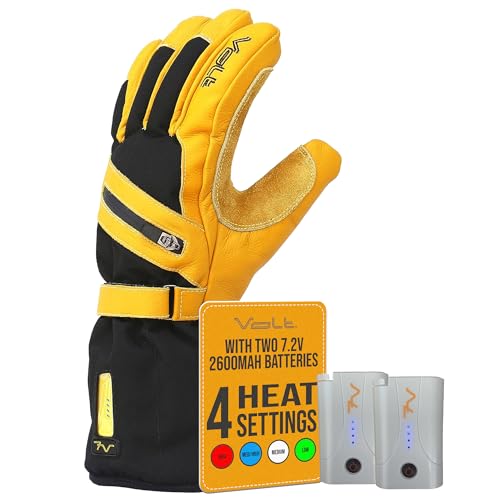
Where to find it. The Fusion is sold direct by Volt rather than through Amazon, and sits well above the everyday brands on price. That is defensible for a glove doing two jobs and the wrong purchase if you only need one. The buy buttons on this page point at the leather work glove, which is the model most of the durability reporting below refers to.
Built for work, not for walking the dog
The durability reports are the strongest we have seen in this category. Owners using them for farm work, chainsaw work and handling chains describe leather and stitching holding up across three seasons of daily winter use. One reported burning the back of a glove with a cutting torch without losing function, which is not a test we would have thought to run.
Volt’s Zero Layer system is the technical claim behind this: heating elements integrated to reduce bulk rather than added as a layer, which is why the gloves stay usable for actual work. Reviewers consistently note better dexterity than the thickness would suggest.
That focus explains the price and also who should skip it. If your hands are cold on a commute, you are paying for durability you will never use.
Getting the battery in is a nuisance
The single most consistent gripe across owner reports has nothing to do with heat. The battery pocket is awkward to load: the connecting cable is short, so you have to slide the pack partway in, connect it inside the glove, then push it home. Several owners describe it as fiddly, and one noted that forcing it appears to strain the wiring.
That second point matters more than the first. At least one owner reported a glove that stopped heating after heavy use, and repeated wrestling with a short cable in a tight pocket is a plausible route to that. It is a design detail rather than a fault, but it is worth being gentle with.
The lifetime warranty, and what it excludes
Volt’s headline warranty is genuinely better than its competitors. Within the first year, a manufacturing defect gets repaired or replaced at no cost beyond shipping. Beyond that, the garment stays covered for its lifetime under a pro-rated schedule of processing fees rather than expiring outright. Nobody else on this site offers that.
Now the part the headline does not mention: batteries and chargers are covered for ninety days. Heated apparel of every brand fails at the battery or the wiring long before the fabric goes, so the lifetime cover applies to the component least likely to need it.
| Brand | Garment | Batteries |
|---|---|---|
| Volt | Lifetime limited | 90 days |
| ORORO | 1 year | 1 year |
| Savior Heat | 180 days | 180 days |
Read that table twice before deciding which warranty is best for you. Volt covers the glove for longer than anyone. ORORO covers the batteries for four times as long. Which matters depends on what you expect to break, and on the evidence across this whole category, it is the batteries.
Pros and cons
What works
- Runtime claims close enough to reality to plan around
- Durability reports across three seasons of hard use
- Dual 12V and 7V on the Fusion range, unique here
- Lifetime limited warranty on the garment
- Better dexterity than the build suggests
Worth knowing
- Batteries and chargers covered for only 90 days
- Battery pocket is fiddly and may strain the wiring
- Considerably more expensive than the everyday brands
- Lifetime cover is pro-rated after year one, not free
- Overkill if you only need warm hands on a commute
What actual owners report
The reports that matter here come from people using these gloves for work rather than for comfort, which makes them a harder test than most heated gloves ever face.
Durability dominates the praise: leather and stitching surviving seasons of chainsaw work, chains and equipment. The complaints cluster on the battery pocket and on runtime being adequate rather than generous, which is a fair description rather than a criticism.
Owners consistently praise
- Leather and stitching lasting three seasons of daily use
- Working outdoors far longer than without them
- Dexterity good enough for real tasks
- A company that responds when contacted
Common complaints
- Battery pocket difficult to load
- Two to three hours in genuine working cold
- Wiring failures after heavy use
- Price against the everyday brands
Summary of recurring themes across retailer reviews, independent long-term reviews from riders and outdoor workers, motorcycling publications that have tested the Fusion range, and Volt’s own published warranty and product documentation. Current as of August 2026. We report the patterns we see, positive and negative, and never cherry-pick.
The details
Specifications vary across Volt’s range, which spans work gloves, ski gloves and the dual-source Fusion line. Check the listing for the pair you are buying, particularly on power options, since only the Fusion range takes 12V. The current price is pulled live from Amazon.com and refreshes automatically.
Common questions
Is the lifetime warranty as good as it sounds?
On the glove itself, yes, and nobody else on this site matches it. Note two things: batteries and chargers are covered for ninety days only, and beyond the first year the lifetime cover is pro-rated through a processing fee schedule rather than free. It is still the best garment warranty in the category.
What is the difference between the Fusion and the standard gloves?
The Fusion range accepts 12V power from a motorcycle as well as 7V batteries, so it works wired on the bike and cordless off it. The standard range is battery only. If you do not ride, the Fusion premium buys you nothing.
How does it compare to ORORO?
ORORO costs less and covers its batteries for a year rather than ninety days, which matters because batteries are what fail. Volt is better built, lasts longer in hard use, and offers the dual-source option. For everyday cold hands, ORORO. For work or riding, Volt.
Why is the battery so hard to fit?
The connecting cable inside the pocket is short, so the pack has to go partway in before you connect it. Slide it in first, connect inside the glove, then push home. Forcing it appears to strain the wiring, which is worth avoiding on a glove you intend to keep for years.
Will 12V gloves drain my motorcycle battery?
Not while the engine runs, since they draw from the alternator. Testing puts the Fusion at roughly two amps per glove when heating and charging the 7V pack at the same time, so check what your bike can spare before adding a heated vest too. Our motorcycling guide covers this.
Are they worth the extra money?
If you work outdoors or ride through winter, the durability reports justify it and the warranty adds to that. If you want warm hands on a school run, they do not, and you would be paying for toughness you will never test.
Should you buy them?
Volt is the brand to buy if the gloves have a job to do. Farm work, chainsaws, riding through winter, long days outside where a pair failing in January is a real problem rather than an inconvenience. The build reports back that up across seasons, and the runtime claims are among the few in this category you can plan around.
Buy them knowing the warranty covers the glove for life and the batteries for ninety days, and budget for a replacement pack in a couple of years. If that sounds like more glove than you need, ORORO costs considerably less and covers its batteries for longer. Both appear in our roundup of the best heated gloves.
Check price on Amazon ›