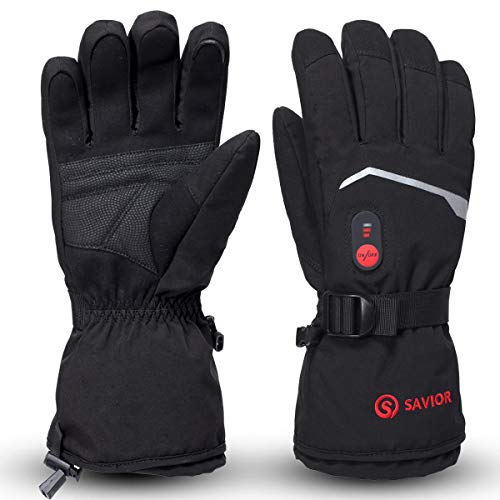
out of 5 Best for Raynaud’s
The warmest gloves in the budget bracket, with elements wrapping the whole hand and a genuinely low low setting. The runtime claims are the least accurate we have seen, and support is the real risk.
Prices are shown in US dollars from Amazon.com as of 2026-10-21 and are subject to change; the figure at checkout is the one that applies. As an Amazon Associate we earn from qualifying purchases, at no extra cost to you, and it never affects our scores.
Very warm, very cheap, and one real risk
Savior Heat sits at the bottom of the price range and near the top of the warmth range, which is an unusual combination and the reason the brand keeps turning up in recommendations. Independent testers have called it the best budget heated glove outright, on the basis that even the lowest setting keeps hands comfortable on the coldest days.
The brand also markets explicitly to people with Raynaud’s, arthritis and poor circulation, and unlike most such marketing there is something behind it: the elements wrap the whole back of the hand and continue down every finger, and the low setting is low enough to run for hours rather than delivering a short blast.
Two things hold the score down. The published runtime figures are further from reality than any other brand we have looked at, and they are not even consistent between Savior’s own listings. And the support record is genuinely poor, which matters more on a cheap product than an expensive one, because the warranty is the only thing standing between you and buying again.
Best for: cold hands at rest, Raynaud’s and circulation problems, skiing on a budget, and anyone who wants maximum warmth per dollar and can accept the risks below.
How it scores, category by category
These are our editorial ratings, weighted into the overall score. They reflect the pattern of owner reports and independent testing rather than bench work of our own.
Runtime: the claims do not survive contact
This is where Savior loses most of its points. The figures below are what the brand publishes against what independent testing found. Note also that Savior’s own listings disagree with each other: one set of materials quotes ten hours on low, another quotes five to six for the same brand.
| Setting | Claimed | Independently measured |
|---|---|---|
| Low | 6 to 10 hrs | 4 to 5 hrs |
| Medium | 3.5 to 6 hrs | Between the two |
| High | 2 to 3 hrs | 1 to 2 hrs |
Claimed ranges span the different figures Savior publishes across its own listings and retail partners. Measured figures come from independent ski-gear testing. The batteries are 7.4V and either 2200 or 3000 mAh depending on model, so roughly 16 to 22 watt-hours: respectable capacity, which makes the gap between claim and reality a claims problem rather than a battery problem. See how watt-hours predict runtime.
Plan on roughly half the headline figure. That still gets you four hours of usable warmth on low, which is enough for most days out, but it is not the ten hours the box suggests and you should not build a plan around it.
The warmth is real, and it is the reason to buy
Elements wrap the whole back of the hand and run down every finger. Independent testers describe the inside of the glove going from cosy to genuinely hot once the heat is running, and note that even the lowest setting is enough on the coldest days. That is a stronger warmth verdict than most heated gloves earn at any price.
The temperature figures Savior publishes are around 104 to 110°F on low, 113 to 122°F on medium and 140 to 150°F on high. Those are claims rather than measurements, but the shape matches what owners describe: a low setting you can leave running, and a high setting for warming up fast rather than staying on.
Odd control behaviour worth knowing. The gloves power on at High, hold it for about five minutes, then drop to Medium automatically. Getting back to High means short-pressing through the whole cycle. Sensible for battery life, mildly irritating in practice.
Why these come up for Raynaud’s
Savior markets directly at Raynaud’s, arthritis and poor circulation, and the design supports it better than most. Full-hand element coverage matters when the problem is blood flow rather than ambient cold, and a low setting you can run for hours is more useful than a high setting that empties in ninety minutes.
The thin liner version is the one Savior itself recommends for indoor use, which is worth knowing if your hands go cold at a desk rather than outdoors. Thin enough not to interfere with typing or writing, but not warm enough to wear alone outside for long. It also doubles as a layer inside work gloves you already own.
One caution that applies to any heated glove in this context: fit matters more than heat. A glove tight enough to compress your hand restricts the circulation you are trying to help, which can leave you colder than you started. Size up.
Not a wet-weather glove
Independent testing is blunt about this: weather resistance is poor and the gloves are not waterproof. Savior describes them as water resistant and windproof, which is accurate as far as it goes, but this is not a glove for sustained rain or wet snow. In a dry cold it is excellent. In a wet cold it is the wrong purchase.
Dexterity is described as average. The touchscreen forefinger works reliably, which is more than can be said for many, but these are not gloves to work in.
Support, and why it costs the score
This is the part that separates Savior from ORORO, and it goes the wrong way. The warranty is 180 days on heating elements and batteries, half the cover ORORO offers. And the support record behind that warranty is poor: independent review platforms carry repeated accounts of unanswered emails, difficulty reaching anyone by phone, and returns that dragged on.
That matters more than it would on a well-built product, because heated apparel of every brand fails at the battery or the wiring eventually. With ORORO, a failure in month eight is an inconvenience. With Savior, on current evidence, it may simply be the end of the gloves.
How to reduce the risk: buy through a retailer with its own returns process rather than direct, so you have a second route if the manufacturer does not respond. Keep the order confirmation, and test the gloves properly within the return window rather than saving them for the first cold snap.
Pros and cons
What works
- Among the warmest heated gloves at any price
- Elements wrap the whole hand, not just the knuckles
- Low setting is genuinely low, so it runs for hours
- Reliable touchscreen forefinger
- Two batteries and a dual charger included
Worth knowing
- Runtime claims roughly double what testing finds
- Support record is the weakest of the brands we cover
- 180-day warranty, half what ORORO offers
- Not waterproof; poor in wet conditions
- Control cycle makes returning to High fiddly
What actual owners report
Owner sentiment splits cleanly. The product itself earns strong marks, and the company behind it earns poor ones. That split is the whole story of this review.
Warmth and value dominate the praise, with Raynaud’s sufferers among the most positive. The complaints are almost entirely about the company rather than the gloves: unanswered support, slow returns, and problems getting a warranty claim resolved.
Owners consistently praise
- Warmth that solves the problem outright
- Relief for Raynaud’s and cold-hand conditions
- Price, particularly against motorcycle brands
- Two batteries and a charger in the box
Common complaints
- Support that does not respond
- Runtime well short of the claims
- Wet weather performance
- Occasional units arriving faulty
Summary of recurring themes across retailer reviews at Amazon and Walmart, independent gear testing, motorcycling and skiing communities, and Savior’s own published documentation. Current as of August 2026. We report the patterns we see, positive and negative, and never cherry-pick.
The details
Specifications from Savior’s published product data, which varies between models and between retailers. Battery capacity in particular differs across the range, so check the listing for the pair you are buying. The current price is pulled live from Amazon.com and refreshes automatically.
Common questions
Are Savior Heat gloves good for Raynaud’s?
They are among the better options, because the elements cover the whole hand rather than stopping at the knuckles and the low setting runs for hours. Fit matters as much as heat here: a tight glove restricts circulation and works against you, so size up.
How long do the batteries really last?
Roughly four to five hours on low and one to two on high, against claims of six to ten and two to three. Plan on about half the headline number.
Why do the gloves drop from High to Medium on their own?
By design. They power on at High for about five minutes to warm your hands quickly, then step down to Medium to preserve the batteries. Returning to High means short-pressing through the cycle.
Are they waterproof?
No. Water resistant and windproof, which is fine for dry cold and light snow. Independent testing rates weather resistance as poor, so look elsewhere for a wet climate.
Savior or ORORO?
Savior for outright warmth per dollar and for circulation problems. ORORO for the better warranty and a support operation that answers, which matters because heated gloves do fail. If the price gap is small, ORORO is the safer buy.
Should I get the gloves or the liners?
The gloves for outdoors, the liners for indoors or inside gloves you already own. Savior positions the liners as the indoor option for people whose hands go cold at a desk, and they are thin enough not to interfere with typing. They are not warm enough to wear alone outside for long. Our guide to gloves versus liners covers the fit test that decides it.
What happens if they stop working?
The warranty runs 180 days on elements and batteries. Getting a claim answered is the weak point on current evidence, so buy through a retailer with its own returns process rather than direct, and test the gloves properly inside the return window.
Should you buy them?
If warmth per dollar is the priority, or if your hands are cold because of circulation rather than weather, these are hard to beat. They are warmer than gloves costing twice as much, the coverage is right, and the low setting is genuinely usable all day.
Buy them understanding two things. The runtime will be about half what the box says. And if something fails, you may be on your own, so buy through a retailer whose returns process you trust. If you would rather pay a little more for a warranty that gets honoured, ORORO is the safer choice, and both appear in our roundup of the best heated gloves.
Check price on Amazon ›